Diese Veranstaltung ist bereits beendet.
** please scroll down for English version **
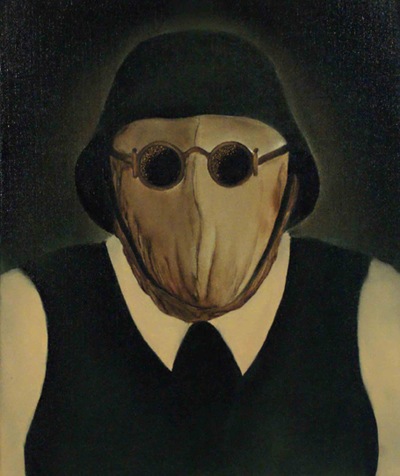
Michał Jankowski gehört zu einer jungen Generation von Künstlern, deren Stil oft als „Müde von der Realität“ bezeichnet wird. Sie beziehen ihre Inspiration nicht aus der sie umgebenden Realität, sondern vielmehr aus surrealistischen und phantastischen Welten, Träumen oder Halluzinationen.
Mit dem Bewusstsein vergangener Jahrzehnte und Strömungen folgt Jankowski den Spuren des Surrealismus. Seine neusten Werke aus der Serie Astronauten (2011) sind von den Klassikern des polnischen Experimentalkinos der 1950er und 1960er Jahre der Regisseure Walerian Borowczyk und Jan Lenica inspiriert. Diese beiden Vorreiter und Pioniere des Absurden Films waren wiederum von der französischen Avantgarde der 1920er Jahre, vor allem durch Surrealismus und Dadaismus beeinflusst. „Die Filme von Borowczyk und Lenica waren für mich der Start- und Ausgangspunkt meiner Arbeit ... Ich versuche, diese unglaubliche Atmosphäre des Grauens, des Grotesken und des Absurden, die ich in ihnen entdeckt habe und der ich mich sehr verbunden fühle abzubilden,“ so Jankowski. Die Animationsfilme der 1950er Jahre sind für ihn nicht nur eine Fundgrube von Motiven und Retroästhetik, sondern ein ironischer Kommentar zur conditio humana. Unter einer dünnen Schicht aus schwarzem Humor und Grauen verbergen sich existenzielle Botschaften die an Franz Kafka oder Eugène Ionesco denken lassen. Jankowski bezieht sich in seinen Arbeiten nicht zum ersten Mal auf das Kino, bereits frühere Zyklen verweisen unter anderem auf die Filme Stroszek oder Jeder für sich und Gott gegen alle von Werner Herzog. Sie alle kann man als eine Metapher des menschlichen Schicksals verstehen.
Jankowski baut für die Philosophie seiner Malerei eine Art Stammbaum auf. Indem er auf die 1950er und 1960er, und damit auch indirekt auf die 1920er Jahre, zurückgreift, untersucht er, was heute von den vergangenen Revolutionen der Kunstwelt übrig geblieben ist: „Filme wie „Astronauten“, „Haus“ oder „Schule“ waren zur damaligen Zeit etwas völlig Neues und Einzigartiges. Sie waren in ihrem Genre Vorreiter und Revolutionäre. Für mich sind Borowczyk und Lenica Entdecker neuer Welten, Pioniere und furchtlose Eroberer.“ In Anlehnung daran, entstand der Titel seiner aktuellen Ausstellung – Astronauten – die in der Galerie ŻAK | BRANICKA zu sehen ist.
Das Hauptthema seiner Arbeiten sind oft die den Beginn von etwas Neuem begleitenden Phänomene von Isolation, Widerstand und Negation. Kann man aber heute in der Kunst tatsächlich derart sorglos bahnbrechend und schmerzlos innovativ sein? Dies erscheint fragwürdig, denn das Bewusstsein und das Wissen sowohl des Betrachters wie auch des Künstlers können zugleich zur Belastung werden. Wenn durch jeden Blick auf die Bilder Jankowskis zeitgleich einen Schatten von Phillip Guston, Hieronymus Bosch oder Francis Bacon darauf geworfen wird, bleibt nichts mehr übrig als ein Katz und Maus Spiel mit der Kunstgeschichte.
Diese traurige Feststellung, dass es alles schon gibt, führt also zur instinktiven Selbstzerstörung des Bildes. Präzise, beinahe wie von Alten Meistern gemalte Figuren und Objekte zerfallen auf Jankowskis Bildern in ihre einzelnen ¬Atome, die an Sternenstaub erinnern, nur um daraufhin wie ein Phoenix aus der Asche aufzuerstehen.
** English**
Michał Jankowski is part of the younger generation of artists, often labelled as “tired of reality,” the source of whose art is to be found not in the surrounding reality, but in the imagination, dreams, or hallucinations.
Jankowski is following the path of surrealism in full consciousness of the decades and movements that have passed. His latest series, "Astronauts" (2011), is inspired by the work of two classics of experimental filmmaking from the turn of the 1950s/60s – Walerian Borowczyk and Jan Lenica – who are regarded as pioneers and precursors of the world surrealism scene in the cinema of the absurd. This avant-garde arts duo was inspired, in turn, by the French avant-garde of the 1920s, chiefly by the surrealists and the dadaists. “The films of Borowczyk and Lenica are my point of departure, my starting point ... I try to submit to that remarkable atmosphere of horror, grotesque, and absurdity I found in them, and which is very close to my own sensibility”, says Jankowski. For him, the animation of the 1950s is not only a visual goldmine of motifs and "retro" aesthetics (his pictures draw such motifs from Lenica and Borowczyk as a man in a bowler hat, and a woman with a flower-face), but above all it is an ironic commentary on the "conditio humana". Under the thin layer of black humor and horror are existential themes culled from Franz Kafka or Eugène Ionesco. This is not Jankowski’s first allusion to the cinema in his work: his earlier series of works drew from Werner Herzog’s "Stroszek" and "Kaspar Hauser". They all can be read as metaphors of human fate.
Jankowski is building a family tree for his painterly philosophy, and in reaching back to the 1950s/60s and – indirectly – to the 1920s, he is exploring what is left of past revolutions in art. “The films of Lenica and Borowczyk, such as “Astronauts,” “The House,” or “School,” broke the mold, they were original, innovative, pioneering – they discovered new worlds. The two filmmakers can be considered as heroes, explorers, and fearless conquerors,” Jankowski states. This accounts for the exhibition’s title – ASTRONAUTS – presented at ŻAK | BRANICKA gallery.
The subject of his work is often the isolation, rebellion and negation that accompanies every birth of the new. Can today’s artist be so cheerfully innovative, so painlessly adventurous? It seems unlikely, because the consciousness or knowledge of the viewer is as much a burden as the consciousness of the artist. When every glance at a painting by Jankowski casts a shadow of Philip Guston, Hieronymus Bosch or Francis Bacon, nothing remains but a conscious game of hopscotch with art history.
This sad recognition that everything has already been done thus leads to instinctive self-destruction, and to the destruction of the components of the picture. The beautiful figures and objects in Jankowski’s work, painted almost Dutch-style, disintegrate into individual atoms, or something recalling a magic, cosmic dust – just to be reborn like a Phoenix from the ashes.